

Larrier named ASTRO Fellow
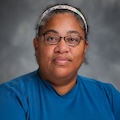
Nicole Larrier, MD, MS, was named a Fellow of the American Society for Radiation Oncology (ASTRO) for 2025. The distinction honors individuals who have contributed significantly to the Society and to the field of radiation oncology in the areas of research, education, patient care or leadership. Duke Radiation Oncology is proud to have 15 Fellows of ASTRO among our faculty (including emeritus faculty; not including adjunct faculty).
Salama named ASCO Fellow
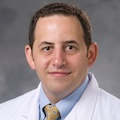
Joseph Salama, MD, was named a Fellow of the American Society of Clinical Oncology (ASCO) for 2026. The distinction honors members for engagement and dedication to the American Society of Clinical Oncology and the Association for Clinical Oncology.
Dr. Salama was also appointed co-chair of the Alliance for Clinical Trials in Oncology Radiation Oncology Committee.
Sulman named Interim Executive Director of DCI

Erik Sulman, MD, PhD, was named the interim executive director of the Duke Cancer Institute (DCI) in January 2026. Dr. Sulman will continue to serve as chair of Radiation Oncology while assuming this additional leadership responsibility. “These past few months have already shown me the incredible talent, collaboration and dedication within our department and across the cancer community here,” said Dr. Sulman.
Lafata awarded $2.9 million R01 to advance digital twin models in cancer research
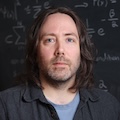
Kyle Lafata, PhD, and professors of radiology Cristian Badea, PhD, and Paul Segars, PhD, were awarded a $2.9 million MPI R01 grant by the NIH National Cancer Institute. The project is titled “Development of a virtual preclinical CT platform for advanced imaging and theranostics in head and neck cancer,” and runs from September 2025 to August 2029. Resistance in head and neck cancer can limit the effectiveness of current treatments. The Duke team is addressing this challenge by combining photon-counting CT imaging, experimental mouse models and multiscale mathematical modeling to gain new insights into tumor behavior and therapy response.
Lee, Palta awarded $2.8 million U01 for research on radiation-induced heart disease
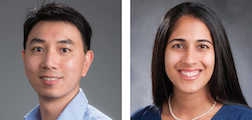
Chang-Lung Lee, PhD; Manisha Palta, MD; and Professor Emeritus of Pathology Salvatore Pizzo, MD, PhD, were awarded a $2.8 million U01 grant by the NIH National Institute of Allergy and Infectious Diseases. The grant runs from August 2025 to July 2030; other co-investigators include Duke Radiation Oncology current and former faculty Christopher Kelsey, MD; Pooja Karukonda, MD; and Trey Mullikin, MD. So far, the team has shown that serological pro-N-cadherin (PNC) is a promising diagnostic marker in screening the general population for subclinical heart failure. The grant aims to develop this as an early biomarker to identify individuals at high risk of developing heart disease following radiation exposure.
Lee, Eyler awarded R21 for research on GI-ARS
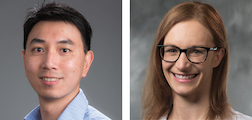
Chang-Lung Lee, PhD, and Christine Eyler, MD, PhD, were awarded a $317,000 MPI R21 grant by the NIH National Institute of Allergy and Infectious Diseases. The grant runs from August 2025 to July 2027; it aims to investigate the epigenetic and transcriptional mechanisms governing the regeneration of intestinal stem cells following radiation-induced damage, with a focus on multipotent revival stem cells.
Reitman awarded ALSF grant
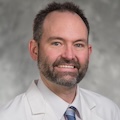
Zach Reitman, MD, PhD, was awarded a 2025 Young Investigator Summit Shark Tank grant from Alex’s Lemonade Stand Foundation (ALSF, funded by Northwestern Mutual) for his project, titled “Protecting CAR T Cells from Radiation.” Dr. Reitman’s project seeks to improve outcomes for patients with high-risk medulloblastoma by enabling CAR T-cell therapy to work more effectively alongside radiation therapy. This Shark Tank award will extend Dr. Reitman’s $800,000 ALSF A Award.
Lee receives RRS J.W. Osborne Award
Chang-Lung Lee, PhD, received the 2026 J.W. Osborne Award from the Radiation Research Society (RRS). He will deliver the award lecture at the RRS annual meeting in October.
Chen, Vicioso Mora receive 2026 Conquer Cancer Young Investigator Awards
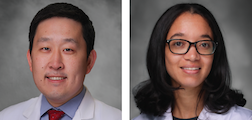
Radiation Oncology Research Scholars Mark Chen, MD, PhD (Class of 2026), and Yorleny Vicioso Mora, MD, PhD (Class of 2027), received 2026 Conquer Cancer Young Investigator Awards. Awards provide funding to promising investigators to encourage and promote quality research in clinical oncology, and aid in the transition from training to a faculty appointment.
Chen wins ASCI Emerging-Generation Award

Mark Chen, MD, PhD, won an American Society for Clinical Investigation (ASCI) Emerging-Generation Award, which recognizes post-MD, pre-faculty appointment physician-scientists who are meaningfully engaged in immersive research; just 29 awards were given in 2026.
Criscuolo receives NCI F31 Grant
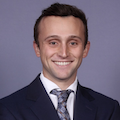
Teddy Criscuolo, PhD student in the Duke Medical Physics Graduate Program, received a Ruth L. Kirschstein National Research Service Award for Individual Predoctoral Fellows (F31) from the National Cancer Institute. Teddy’s project involves a training plan focused on the longitudinal tracking of diffuse glioma. He is mentored by Deshan Yang, PhD, and Evan Calabrese, MD, PhD.
Community spotlight: SECU Caring House
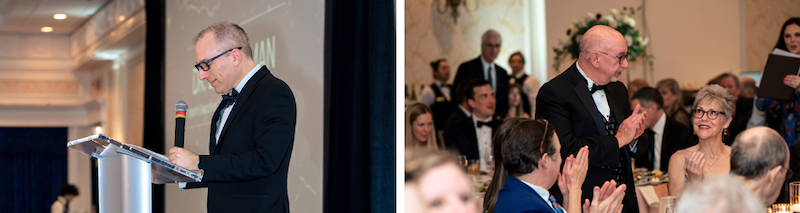
The SECU Caring House was created to offer an affordable refuge for those traveling to receive cancer treatment at Duke. Duke Radiation Oncology served as a Silver Sponsor of the 2026 SECU Caring House Annual Benefit Gala, held in February at the Washington Duke Inn. The evening raised nearly $260,000. Erik Sulman, MD, PhD, interim executive director of DCI, was a featured speaker. Also pictured is Caring House board member John Kirkpatrick, MD, PhD.
Caring House’s Fiscal Year 2025 stats
- 719 guests served from 76 North Carolina counties and 25 states
- 6,190 nights of lodging provided
- 2,335 volunteer hours completed
- $6,320 in needs-based assistance provided