
by Sarah Brady
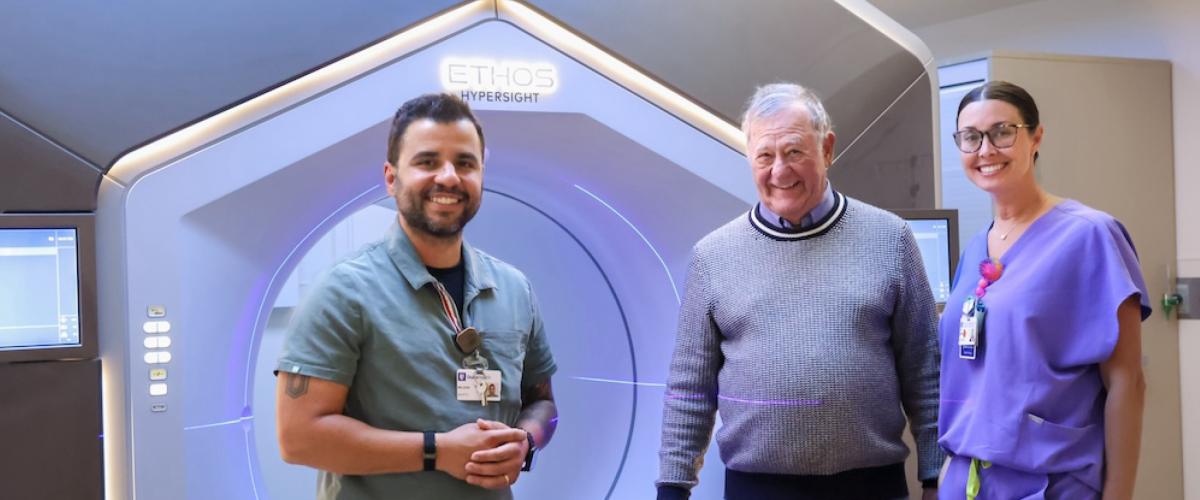
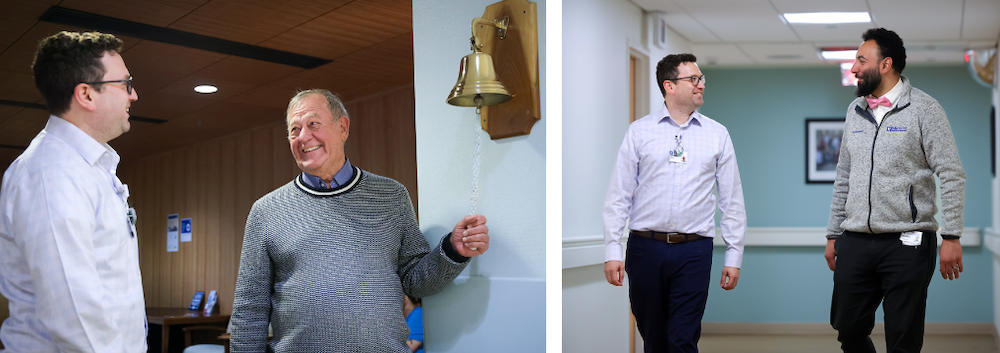
For Duke Radiation Oncology patient Patrick Schultea, the path back to radiation therapy was anything but straightforward.
When his prostate-specific antigen (PSA) levels began to rise nearly two decades after an initial seed implant treatment for prostate cancer at his local hospital, he knew the situation would require careful navigation.
“Surgery was not a good option for me,” Patrick recalled. “I’d already had radiation, and I was a little reluctant to consider it again. Many people will tell you, you don’t do that twice, especially not when you still have remnants of seeds implanted.”
Patrick made an appointment with Duke medical oncologist Andrew Armstrong, MD, MSc, who referred him to radiation oncologist Paul Koffer, MD. Imaging and a biopsy revealed something unexpected. The cancer had not returned to the prostate itself, but to the left seminal vesicle, a gland located between the rectum and the bladder.
That distinction changed the approach. “It made radiation therapy an option for me,” said Patrick, describing it in terms shaped by his military background as a former naval flight officer who flew P-3 Orions and tracked Russian submarines from the air: “I didn’t fly attack planes, but I had friends who did, and there was a term called ‘troops in the open.’ That meant that you had a clear target on the enemy. That’s what this felt like. The cancer cells were in the open and just waiting to get hit.”
Dr. Koffer offered a specialized approach: stereotactic body radiation therapy (SBRT) – high-concentration doses of radiation – delivered on a specialized linear accelerator that utilizes adaptive radiotherapy by modifying radiation plans in real-time to account for changes in a patient’s tumor size or anatomy.
What stood out to Patrick was not just the cutting-edge technology itself, but the logic.
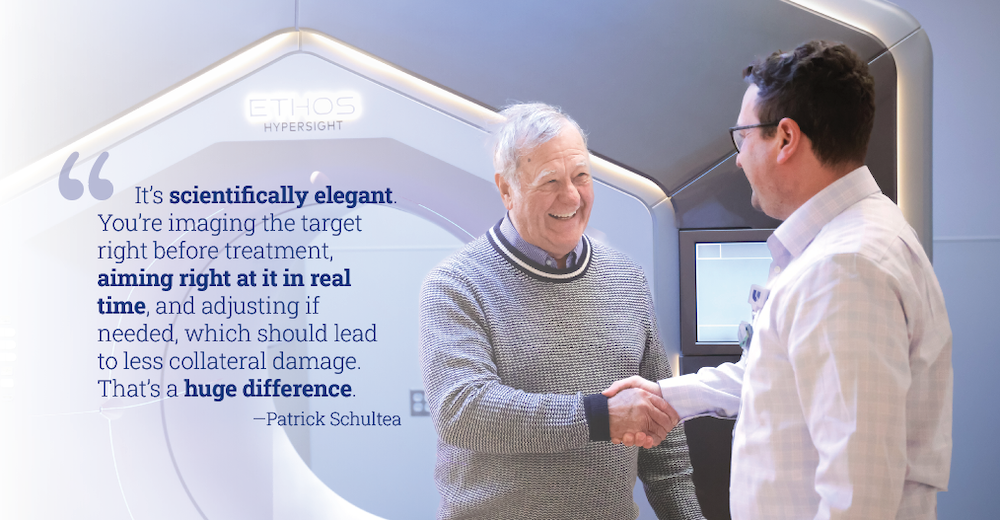
“It’s scientifically elegant. You’re imaging the target right before treatment, aiming right at it in real time, and adjusting if needed, which should lead to less collateral damage. That’s a huge difference.”
Additionally, unlike conventional radiation therapy, which can involve dozens of treatments over the course of several weeks, Patrick’s course consisted of just five sessions lasting about 30 minutes each. There was minimal disruption to his daily life.
“It’s noninvasive, and when you’re done, you’re done,” he said. “I don’t believe I’ve had any side effects from my treatment. If any, they’ve been very mild and consistent from what I still have from the seeds. So this was a no-brainer for me.”
The adaptive capabilities of the specialized linear accelerator were particularly important in Patrick’s case. Because of the residual seeds from earlier treatment, precision was critical, and the system’s ability to refine the treatment plan in real time allowed the clinical team to avoid previously irradiated areas while focusing on the new target.
“That’s the beauty of it. They can adapt if they need to. You’re not hitting something you don’t intend to hit, whether that’s healthy tissue or the remnants of seeds. There’s a lot of valuable real estate in that part of the body, and you don’t want to damage it if you don’t have to. This technique lets you be precise, and that makes all the difference.”
Like many patients, Patrick brought a tool into his decision-making process: artificial intelligence (AI), which he clarified that he used with caution, taking recommendations with a grain of salt. Before going into his appointment with Dr. Koffer, he reviewed his biopsy and imaging reports in detail and used AI to help interpret the data and explore potential options. When Dr. Koffer recommended SBRT, it aligned immediately with what he had been considering.
“I remember thinking, this is the easiest decision I’ve ever made,” he said. “Everything lined up – the data, the technology and what Dr. Koffer recommended to me.”
Now, having completed treatment, Patrick is in a period of watchful waiting. He’s tracking his PSA levels until he completes follow-up imaging – and in the meantime, he’s living life fully, including taking a recent trip with his wife to the Rock & Roll Hall of Fame in Cleveland, Ohio; renovating his Beaufort, North Carolina beach house that’s been in the family since 1929; and rowing boats as part of the Beaufort Oars Rowing Club.
Stories like Patrick’s illustrate more than a successful treatment. They highlight a shift in what’s possible. Adaptive therapy recognizes that every patient’s anatomy and experience is unique, requiring a targeted approach.
Investing in Innovation: Bringing Adaptive Therapy to Duke
Patrick’s experience reflects Duke’s significant investment in adaptive therapy technology.
In January 2025, Duke Radiation Oncology announced the successful installation of the first of two advanced image-guided radiation therapy (IGRT) systems, designed to deliver efficient treatment times and enhanced imaging quality. Adaptive treatment for patients on the first machine began in November 2025.
In May 2026, Duke’s second specialized treatment system was successfully installed.
“Being the first in North Carolina to bring adaptive therapy into the clinic was a milestone for Duke Radiation Oncology, but it was also a reflection of a commitment to continuously advancing patient care,” said Mohamed Badawi, BSc, CSTM, MBA, Duke Radiation Oncology’s technology and facilities administrative director. “Innovation in radiation oncology isn’t about staying current for its own sake. It’s about giving patients access to more precise, personalized treatments that can improve outcomes and reduce side effects. That kind of progress requires meaningful investment, not only in cutting-edge technology, but in the people who make it possible – our team and our patients.”
Introducing new technology, Mohamed explained, is a thoughtful, multi-layered process that starts well before it ever reaches a patient. “You have to bring the team on board first, making sure everyone understands the ‘why’ behind the decision and feels confident using the tools,” he said. “When clinicians and staff are fully aligned, it creates a stronger foundation for delivering high-quality care.”
From there, the focus shifts to long-term integration. “It’s not only about acquiring new equipment,” Mohamed added. “It’s about understanding how it fits into our existing infrastructure and how it will support us years down the line. At the same time, we’re evaluating how it impacts clinical workflow, making sure day-to-day operations remain efficient.”
That balance, between innovation, integration and usability, is what ultimately drives better care. “Every step of the process is intentional,” he said. “At the end of the day, investing in technology is about investing in better experiences and outcomes for our patients.”
The Clinical Value of Adaptive Therapy
For physicians, much of the clinical value lies in the ability to respond to daily anatomical variation. “Adaptive radiation allows us to tailor treatment not just for a specific patient, but for a specific patient on a specific time and day,” Dr. Koffer explained. “If the tumor or nearby organs shift, we can adjust on the fly. It also allows us to give higher doses than we could safely give with traditional radiation techniques.”
This is particularly relevant in anatomically dynamic regions. A good example is the bowel, which can move significantly from day to day. This makes certain abdominal and pelvic tumors ideal cases for adaptive therapy; seeing the organs in real-time allows for the physician to account for variability and reduce unintended dose to surrounding tissue, according to Dr. Koffer. He also points to reirradiation – cases like Patrick’s, in which an area has already been previously irradiated, and may have the risk of toxicity – as a key application.
Delivering that level of control requires a highly coordinated team. “Adaptive treatments involve more people and more steps,” said radiation therapist Nelson Santana, BA, RT(T). “You have therapists, physicists and physicians all working together in real time, and there are a lot more moving parts when it comes to adaptive.”
Behind the Scenes: Commissioning and QA
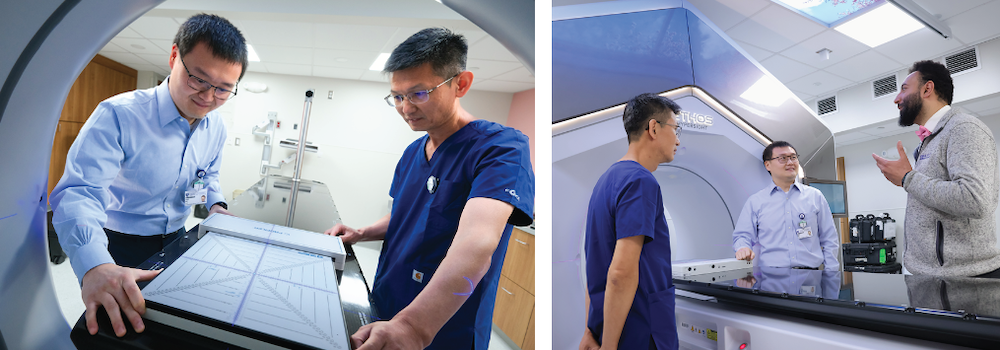
From a radiation physics perspective, using adaptive therapy introduces new challenges in quality assurance (QA) and system design. “Commissioning an adaptive-capable machine must encompass the entire adaptive treatment workflow,” said Yunfeng Cui, PhD, one of the physicists who worked on commissioning Duke Radiation Oncology’s two adaptive radiation therapy machines. “This includes end-to-end testing of imaging, contouring, plan adaptation and delivery processes, as well as ensuring system interoperability.”
Traditional pre-treatment QA methods are not always feasible in a real-time environment. Because new plans are generated and delivered in the same session using tools like artificial intelligence (AI), physicists rely on rapid calculation-based QA tools and continuous review during treatment. “The presence of trained multidisciplinary staff during treatment, such as physicians verifying contours and physicists reviewing plan quality under time pressure, serves as a critical layer of quality assurance in the adaptive process,” said Dr. Cui.
Physicist Yibo Xie, PhD, agreed, emphasizing the importance of human oversight. “We rely on the AI-driven contouring and planning tools to handle the initial heavy lifting, and the system is remarkably efficient, which significantly streamlines the adaptive process,” he said. “That said, we do not treat it as a fully autonomous solution. Physician and physicist oversight remains essential. AI may drive the initial workflow, but clinical judgment remains firmly in control.”
The Road Toward Personalized Cancer Care
Looking ahead, that balance between automation and human judgment is expected to evolve further. “We should see faster workflows and more automation,” said Dr. Xie. “Beyond that, the exciting direction is biologically guided adaptation – using functional imaging or response data to adapt not just to anatomy, but to tumor behavior.”
Duke Radiation Oncology is planning to invest in other adaptive treatment systems as well, specifically a magnetic resonance-guided linear accelerator (MR-LINAC) and a positron emission tomography (PET) based biological adaptive radiation therapy.
“In the future, we will be able to integrate adaptive radiotherapy with other imaging modalities like MRI or PET,” said Manisha Palta, MD. “That will allow for truly personalized cancer care, where radiation dose is based on tumor biology and can be modified during the course of radiation.”
For now, the impact of adaptive therapy at Duke is already tangible in the growing number of patients treated on adaptive platforms. The process may be more resource-intensive, and there may be a learning curve, but the clinical promise is clear, as is the benefit to patients.